Profile
Carroll Shelby gave Mustang a racing accent.
The early Mustang was already a hit. Shelby made it sharper, louder, rarer, and harder to dismiss. His cars taught the public that a Mustang could be judged by lap times as well as showroom lines.
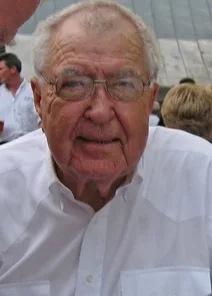
Image rights & changes
- Creator
- Sherry Lambert Stapleton
- Exact source
- Open source record
- Use basis
- CC BY-SA 2.0; this web adaptation is offered under the same ShareAlike license.
- Changes
- Auto-oriented, converted to WebP at source dimensions, and metadata removed.
- Original identity
- Commons SHA-1:
d203e0243d765deeb4552d6cc90d5195e184575d - Public derivative checksum
- SHA-256:
2facedbd5c071bbe63dbd02e64195f02314bbec0da96440982c5db4d37f34f9c - Rights record checked
- July 26, 2026
Chapter 1
Texas speed before the signature.
Carroll Shelby entered the Mustang story with a past that already sounded like legend. He was not a stylist, a corporate planner, or a celebrity hired to sprinkle glamour over a product. He was a Texas racer with international credibility, a man who had flown during wartime, chased speed across rough circuits, and built a reputation in a period when racing still looked improvised, dangerous, and personal. Long before his name landed on a Mustang fender, it meant something to people who followed sports-car racing.
That credibility mattered because Ford's new Mustang had a problem hidden inside its success. The car looked sporty and sold like nothing else, but racers and hard-core performance buyers could still see its softer showroom roots. It was a brilliant personal car, not yet an unquestioned competition machine. Ford could advertise V8 power and bucket seats, but the Mustang needed a different kind of witness: someone from the racing world who could make the car sweat under pressure.
Shelby brought that witness because he had already proved himself outside Ford's walls. His 1959 Le Mans win with Roy Salvadori in an Aston Martin gave him a credential no brochure could fake. When he later stood near a Mustang, the association changed the car's temperature. The public saw a successful Ford. Racers saw Shelby testing whether that Ford could be made serious.
Chapter 2
The racer becomes a constructor.
Health problems pushed Shelby out of top-level driving, but they did not slow the part of him that wanted faster machines. If anything, leaving the cockpit gave him a new role. He could stop being only the man holding the wheel and become the man deciding what the wheel was attached to. Shelby American grew from that transition: part shop, part racing operation, part pressure cooker for ideas that would have looked too crude or too risky inside a polished corporate studio.
The Cobra proved the formula before the Mustang arrived. Put American V8 power into a light, direct, European-style chassis, then let the result speak in noise, speed, and race results. The Cobra was not subtle, and that was the point. It showed Ford that Shelby understood how to turn parts into theatre without losing the mechanical honesty racers respected. He could make a car feel raw and purposeful rather than merely decorated.
That distinction is central to every Shelby Mustang that followed. The Shelby name worked only because it promised changed behavior, not just changed trim. Mustang fans still argue about which later Shelby-branded cars live up to that standard, but the early template was clear. Shelby American would take Ford hardware and make it sharper, meaner, and more accountable to the stopwatch.
Chapter 3
Ford has a hit and wants a halo.
By the time Shelby and Mustang were formally connected, Ford did not need him to rescue a failing car. The Mustang was already a commercial shockwave. Dealers had traffic, buyers had stories, and Iacocca had the kind of public proof every executive wants. But a sales hit and a performance legend are not the same thing. A car can dominate showrooms and still lack authority with people who judge it from the apex of a corner.
That is where Shelby fit. Ford needed Mustang to stretch upward, from desirable personal car to legitimate performance name. Shelby American could do that faster than the normal corporate process because it already lived close to racing. The assignment was not to make every Mustang a race car. It was to create a halo strong enough that even an ordinary Mustang owner could feel a little of its light.
The relationship also made sense for Shelby. The Mustang gave him a mass-market stage larger than the Cobra world. It put his name into Ford dealerships, magazines, parking lots, and eventually bedroom walls. For a constructor whose business depended on reputation as much as machinery, the Mustang was not a compromise. It was a megaphone, provided he could make the car worthy of the noise.
Chapter 4
GT350 gives Mustang teeth.
The 1965 GT350 is where the Shelby Mustang story becomes physical. The base material was the K-code fastback, already the right body and engine path for a sharper car. Shelby American then made the Mustang harder-edged through suspension work, brake changes, engine tuning, weight-conscious choices, visual identifiers, and a general refusal to let the car feel as relaxed as the standard showroom version. The result did not merely say performance. It acted less patient.
That attitude was essential. The GT350 had to convince skeptical enthusiasts that a Mustang could survive outside boulevard duty. The GT350R made the argument more directly by pointing the car at competition. In that form, the Mustang stopped being only Ford's youth-market miracle and started becoming a machine with consequences. It could win, break, punish, and reward like a real race car. That changed how the entire nameplate was read.
The beauty of the GT350 is that it did not erase the Mustang underneath. It revealed another personality inside it. The long hood and fastback roof still carried the popular Ford shape, but Shelby's changes made the car feel like it had been pulled tight. For later Mustang history, that became a permanent idea: somewhere above the regular car there should be a version with less patience and more purpose.
Chapter 5
Hertz, stripes, and public myth.
The Shelby story became larger because it was never only about lap times. The visual language mattered: stripes, scoops, badges, stance, and the sense that the car had escaped from a more serious world than the commuter traffic around it. The GT350H rental program with Hertz added the kind of folklore no cautious marketing department could fully control. A Shelby Mustang that ordinary people could rent sounded almost too good to behave normally, which is why the stories kept growing.
Some of that folklore has to be handled carefully. Enthusiasts love the tales of rental cars returning with evidence of weekend abuse, and the legend often outruns the documentation. But even when the stories are polished by repetition, they point to something true: Shelby had made Mustang feel reachable and forbidden at the same time. The car was in a rental fleet, yet it carried racing flavor. It was a Ford, yet it felt like contraband.
That mix helped the Shelby name survive far beyond the original production numbers. A rare car with a vivid story becomes easier to remember than a rarer car with no mythology attached. The GT350H, the white-and-blue image, and the Shelby American aura gave Mustang an emotional vocabulary that still shapes how owners talk about authenticity, continuation cars, tribute builds, and real-deal paperwork.
Chapter 6
GT500 and the long shadow.
By 1967, the Shelby Mustang story had moved into a different room. The GT500 brought big-block gravity, more image, and a stronger muscle-era flavor. It was still a Shelby, but the tone had changed from stripped road-race impatience toward heavier intimidation. That shift mirrors the broader Mustang arc of the late 1960s, when power and presence pulled the car away from the compact cleverness of the original formula.
Ford's increasing control over Shelby Mustang production also changed the meaning of the badge. The early Shelby American cars feel closest to the shop-floor legend: rougher, more direct, more obviously tied to the constructor's racing instincts. Later cars became part of Ford's larger performance image, still desirable but more complicated. That tension never really disappeared. Every later Shelby Mustang asks the same question in a new decade: is this a Shelby because of what it does, what it wears, or what story Ford wants it to carry?
That is why Carroll Shelby's shadow remains so long over Mustang. He gave the car a performance mythology that Ford could return to whenever the nameplate needed a sharper edge. GT350, GT500, Hertz cars, modern revivals, auction arguments, clone debates, and collector paperwork all trace back to the same transformation. Shelby did not create Mustang. He taught it how to look a stopwatch in the eye.
