Competition Profile
George Follmer was the second blade in the Bud Moore attack.
Parnelli Jones gets the poster, but George Follmer gave the Bud Moore Mustang program depth. His results helped make the 1970 Trans-Am title a Ford campaign instead of a one-driver legend.
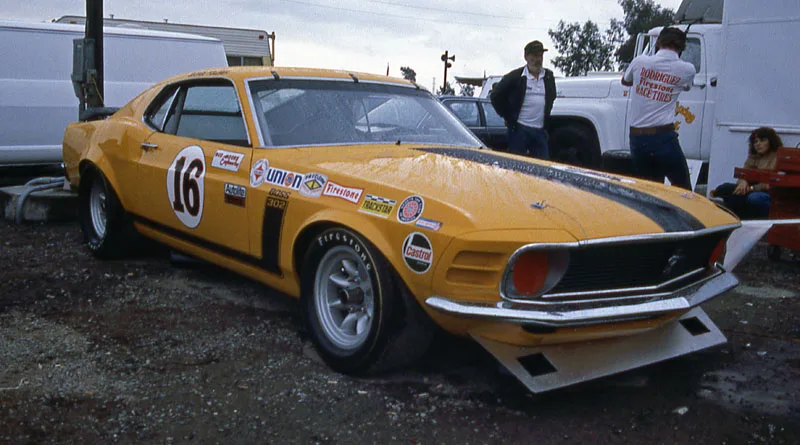
Image rights & changes
- Creator
- Dan Wildhirt
- Exact source
- Open source record
- Use basis
- CC BY-SA 3.0; this web adaptation is offered under the same ShareAlike license.
- Changes
- Auto-oriented, converted to WebP at source dimensions, and metadata removed.
- Original identity
- Commons SHA-1:
7cac516dd8cefaa0149dd766649fa32c6cbfed08 - Public derivative checksum
- SHA-256:
3b056ac11bbca6076207f76a073b3df4e6682236357d1c53e9a33f8020a6387d - Rights record checked
- July 26, 2026
Why Mustang people should care
- The Motorsports Hall of Fame of America credits Follmer with his first Trans-Am victories as a Ford factory driver in a Bud Moore Mustang in 1969.
- He helped Ford win the 1970 Trans-Am championship, then continued in a Bud Moore Mustang in 1971 before moving to AMC.
- His later Trans-Am and Can-Am titles show that the Mustang chapter sat inside a much larger road-racing career.
Mustang connection
Follmer matters because championship programs need more than one flashpoint. A two-car effort forces rivals to respond at every race, gives the team setup feedback from more than one driving style, and creates scoring pressure even when the headline driver has a difficult weekend.
That is the Mustang lesson in Follmer's record. The 1970 Boss 302 campaign is often remembered through Jones and the No. 15 car, but Follmer's work made the Bud Moore Mustangs feel like a team. His career also keeps the Boss 302 story connected to the wider road-racing world of Porsche, Can-Am, and later Trans-Am competition.
Follmer's Road America recovery follows that Mustang into the 1971 fight with Mark Donohue's AMC Javelin, including the lap-four tire failure and the drive back to second.
What to verify
Follmer-linked cars should be researched through race entries, period photos, restoration history, and ownership documents. Pay attention to whether a car is an original Bud Moore chassis, a period privateer car, a later historic-racing build, or a tribute. The visual difference can be subtle, but the historical difference is large.
