Profile
Lee Iacocca made Mustang feel inevitable.
Before the Mustang became a badge, a segment, and a half-century argument, it was a dangerous executive bet: sell young buyers style, choice, and a payment they could imagine signing.
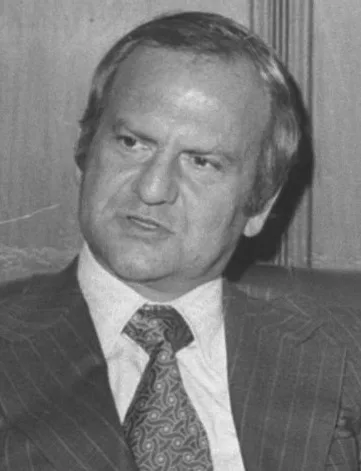
Image rights & changes
- Creator
- João Tavares de Medeiros / Arquivo Público do Estado de São Paulo
- Exact source
- Open source record
- Use basis
- Wikimedia Commons marks the exact file as public domain; the known creator and archive are retained.
- Changes
- Auto-oriented, converted to WebP at source dimensions, and metadata removed.
- Original identity
- Commons SHA-1:
aa377b495c4fd7bf62a1ed95c91393307cc60ccc - Public derivative checksum
- SHA-256:
90015c70b59e461895f5c3cd41341be00a12cfb57280b5f2109e7bd80b7b3047 - Rights record checked
- July 26, 2026
Chapter 1
The engineer who heard the showroom.
Lee Iacocca did not begin as the polished pitchman America later saw on television. He came into Ford after World War II as an engineer, a sensible place for a Lehigh graduate in a company that still measured status by machinery, factories, and the authority of men who knew how cars were made. But the defining turn in his Ford life came when he moved toward sales. In that world, a car was not only steel and horsepower. It was a monthly payment, a dealer conversation, a young buyer's first taste of independence, and a spouse trying to decide whether the dream still looked responsible in the driveway.
That is why the finance campaign remembered as "56 for '56" matters to the Mustang story. It showed Iacocca that the right offer could change a customer's imagination before the customer ever touched the door handle. He learned to think in the space between wanting and buying. Ford could build a perfectly competent car and still miss the moment; it could also package familiar hardware with the right image, price, and rhythm and make the public feel as if the company had suddenly become alert.
By the early 1960s, that instinct was aimed at a market Ford could feel but had not fully named. Younger buyers were not asking for their parents' formal sedans. They wanted style without luxury-car money, performance without a race-car commitment, and individuality without giving up everyday usefulness. Iacocca's gift was seeing that the opportunity was not a narrow sports car. It was a car that let ordinary buyers rehearse a more exciting version of themselves.
Chapter 2
The Fairlane idea becomes a Ford.
The early Mustang conversation moved through concept cars, planning studies, and internal Ford politics. The two-seat Mustang I was dramatic, low, and memorable, but it was also too narrow an answer for the audience Iacocca wanted. A strict sports car could win magazine attention and still leave dealers with a niche product. The production Mustang had to do something harder: look like a personal statement while behaving like a Ford that could be priced, built, serviced, insured, and sold in enormous numbers.
That meant the glamour had to sit on a disciplined business case. Four seats mattered because the car had to be plausible as a daily driver. Falcon and Fairlane component logic mattered because the program needed speed and cost control. The long hood and short deck mattered because buyers had to understand the car before a salesman finished the first sentence. Bucket seats, floor shifters, V8 options, trim choices, and body styles gave the car a choose-your-own-identity quality that was unusual for an affordable Ford.
Iacocca's genius was not that he invented every detail. The Mustang was a team car, shaped by planners, engineers, designers, and executives who fought the problem from different angles. His role was to keep the business story sharp enough to survive those fights. The car had to be affordable, but not plain. Sporty, but not impractical. New, but not so new that Ford had to gamble the company on it. That tension is where the Mustang was born.
Chapter 3
April 1964, the lights come up.
The Mustang launch in April 1964 worked because it felt less like a normal model introduction and more like an arrival. Ford put the car in front of the public with television, magazine coverage, dealer preparation, and New York World's Fair timing. The message was simple enough to cross the country quickly: here was a new Ford that looked expensive, started at an attainable price, and could become mild or wild depending on how a buyer checked the order sheet.
For Iacocca, the launch was the showroom lesson scaled up to national theatre. The car did not need to explain every engineering choice to be understood. People saw the proportions, the grille, the seats, the options, the price, and the crowd forming around it. Dealers suddenly had the kind of traffic that turns a product into a story told by the customers themselves. Mustang became a social object before it became a settled collector category.
The most important part is that the public did not read the Mustang as a compromise, even though its business case was full of practical compromises. Shared components kept the program grounded. The option list made the car feel personal. The launch made buyers feel as if they were getting in early. Iacocca became the visible executive because he could say all of that in a language that sounded less like engineering approval and more like American possibility.
Chapter 4
Success gets heavy.
Success changed the Mustang almost immediately. The car that began as a compact, youthful personal coupe was pulled by the late 1960s toward more power, more body, more luxury, and more muscle-era swagger. Some of that growth made sense. Buyers wanted bigger engines, performance images were selling, and Ford had to keep the car fresh against rivals that had learned from the original Mustang playbook. But every inch and pound also moved the car farther from the original magic trick.
That is the frame that makes Mustang II easier to understand, even for fans who do not love the car. By the time Iacocca had become Ford president, the market was changing under pressure from fuel prices, insurance costs, emissions rules, and a general turn away from the biggest late-muscle excesses. The argument for a smaller 1974 Mustang was not simply a retreat. It was an attempt to pull the nameplate back toward the size-and-value instinct that had made the first car explode.
Mustang II remains controversial because survival cars rarely look heroic in hindsight. Enthusiasts remember what was lost: big engines, raw swagger, and the clean early proportions. But the Iacocca reading is more complicated. He had watched Ford almost outgrow the customer that made Mustang possible. The 1974 car was his answer to a harsh question: if the world no longer rewards the old formula, how small can a Mustang become and still carry the name?
Chapter 5
The exile explains the legend.
Iacocca's firing from Ford in 1978 turned his life into a second-act story, and his Chrysler years made him a public figure far beyond Mustang circles. The Chrysler rescue, K-cars, minivans, and television pitchman persona can feel like a separate biography, but they sharpen the Mustang story. At Chrysler, he again bet on vehicles that were understandable, attainable, and timed to a market need that looked obvious only after someone committed to it.
That pattern is why the Mustang should not be treated as a lucky accident. Iacocca's best work sat at the point where product planning, public appetite, and corporate nerve met. He was not the sole creator of the Mustang, and the car's design and engineering history deserve all the other names attached to it. But he gave the program executive force, a public voice, and a market argument that Ford could rally around when the idea still sounded risky.
The enduring lesson for Mustang people is not that one executive willed a car into existence. It is that the first Mustang understood its buyer with rare clarity. It offered style without asking for exotic-car sacrifice. It sold choice as identity. It made a Ford showroom feel young. That was Iacocca's deepest contribution: he helped Ford build a car that felt less like transportation and more like permission.
