Competition Profile
Parnelli Jones made the Boss 302 feel larger than life.
Mustang had won before 1970, but Jones gave the Bud Moore Boss 302 campaign a headline presence. He brought Indy-winning authority to a pony-car street fight, and the orange No. 15 became one of the most recognizable racing Mustangs ever built.
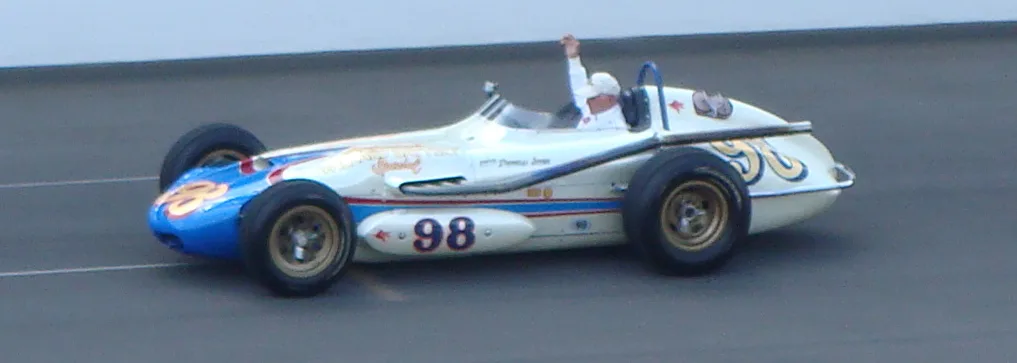
Image rights & changes
- Creator
- Chuck Carroll
- Exact source
- Open source record
- Use basis
- CC BY-SA 3.0; this web adaptation is offered under the same ShareAlike license.
- Changes
- Auto-oriented, converted to WebP at source dimensions, and metadata removed.
- Original identity
- Commons SHA-1:
1d3a57a9b15a7306a9f8f478cdaeaafe76ea3327 - Public derivative checksum
- SHA-256:
b93eca2becf0c4321d76e06b0d2296c4435fbc553a68a0cadb56cc375b0f1a89 - Rights record checked
- July 26, 2026
Why Mustang people should care
- Jones is the driver most fans associate with Bud Moore's 1970 Boss 302 Trans-Am Mustangs.
- His broader career, including the 1963 Indianapolis 500 win, gave Ford's pony-car program star power that went beyond Mustang circles.
- The Jones story is a reminder that Boss 302 value is tied to racing purpose, not only stripes, spoilers, and shaker scoops.
Mustang connection
The Boss 302 road car exists because racing rules demanded a production foundation for the five-liter Trans-Am class. Jones turned that homologation story into theater. In 1970, the Bud Moore Mustangs had to answer Penske's Javelins, Jim Hall's Camaros, the wider factory challenge, and a schedule that punished weak preparation.
Jones brought a combative style that fit the car. The result was not merely a winning Mustang but a personality match: muscular, noisy, and a little intimidating. For many enthusiasts, that pairing is why the Boss 302 still feels like the most direct line between a showroom Mustang and a factory road-racing weapon.
What to verify
For a Jones-associated Boss 302 Trans-Am car, confirm the chassis history through period race records, Bud Moore Engineering documentation, restoration files, and photos that show the same body details over time. For a street Boss 302, verify the VIN, door data, engine codes, transmission, rear axle, and build documentation before treating it as more than a tribute.
