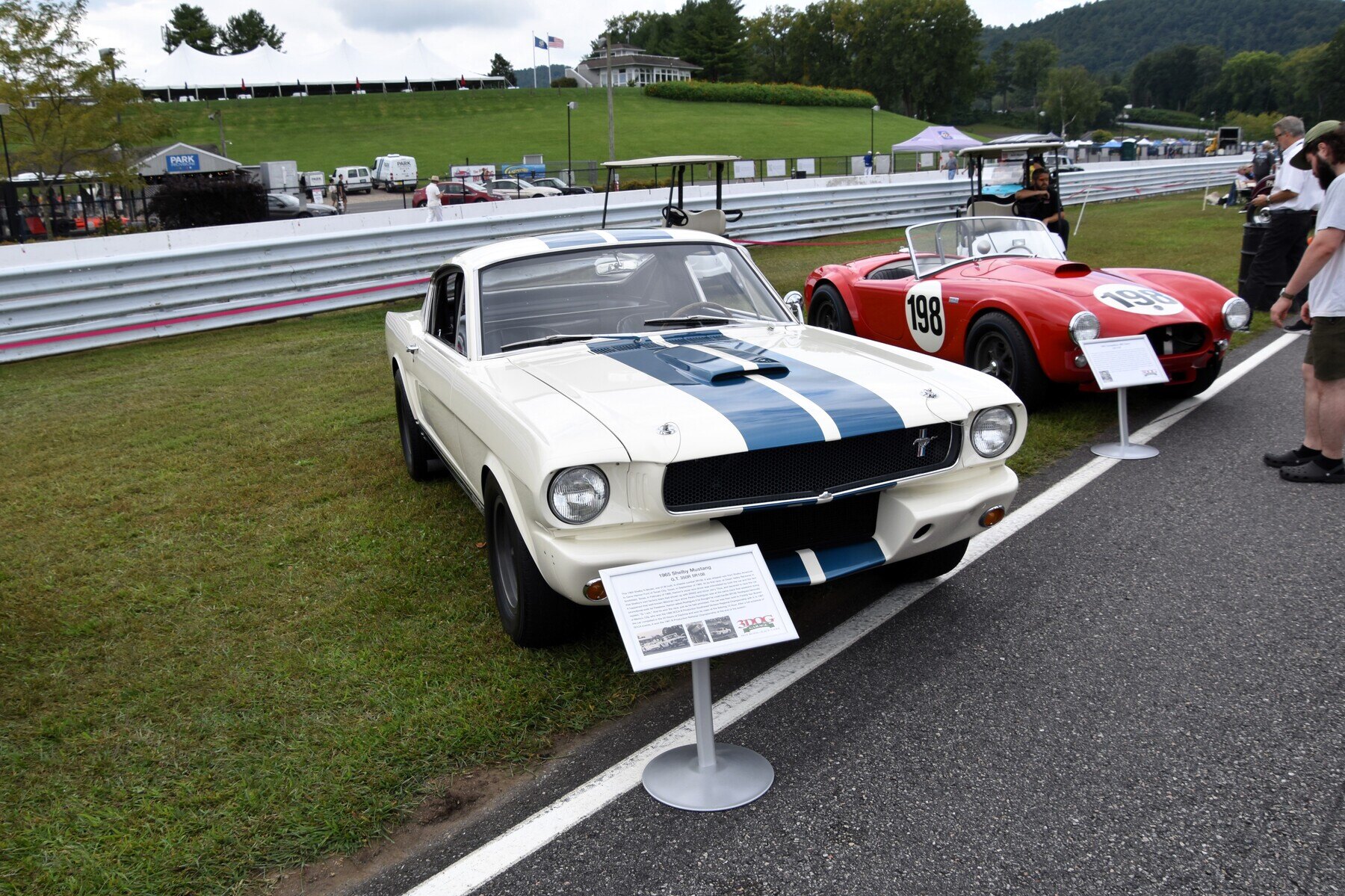
1965 Ford Mustang Shelby GT350 fastback
Photo: Charles from Port Chester, New York · Source · CC BY 2.0
Image rights & changes
Creator
Charles from Port Chester, New York
Exact source
Open source record
Use basis
CC BY 2.0 with creator, exact source, license, and changes identified.
Changes
Reuses the approved gallery derivative: auto-oriented, resized, and metadata removed.
Original identity
Commons SHA-1: 4097d959ee200479c88ee3f081d633936054014c
Public derivative checksum
SHA-256: 180f6663e53fa9e38b099910caa4b77fc605deaac75b68855fa3ab882e4d85b6
Rights record checked
July 26, 2026

SCCA production racing

Shelby GT350R and the first Mustang racing surge

The 1965 Shelby GT350 gave Mustang instant performance credibility, and the GT350R stripped the idea down for SCCA B-Production racing. Jerry Titus, Bob Johnson, Mark Donohue, and Shelby American turned the new fastback into a serious competition car almost immediately.

The road GT350 in this photo shows the body and visual vocabulary behind the competition cars: fastback roofline, Shelby front treatment, side stripes, and the spare, purposeful stance that made the GT350R look less like a promotional special and more like a road-racing tool.

Where surviving cars are
Original GT350R chassis histories are tracked by serial number through Shelby registries, auction dossiers, museum notes, and private-collection provenance.
Why it matters
The GT350R turned Mustang from a hot new street car into an SCCA winner in its first full model year.
People tied to it
Carroll Shelby, Ken Miles, Jerry Titus, Bob Johnson, Mark Donohue, Chuck Cantwell.
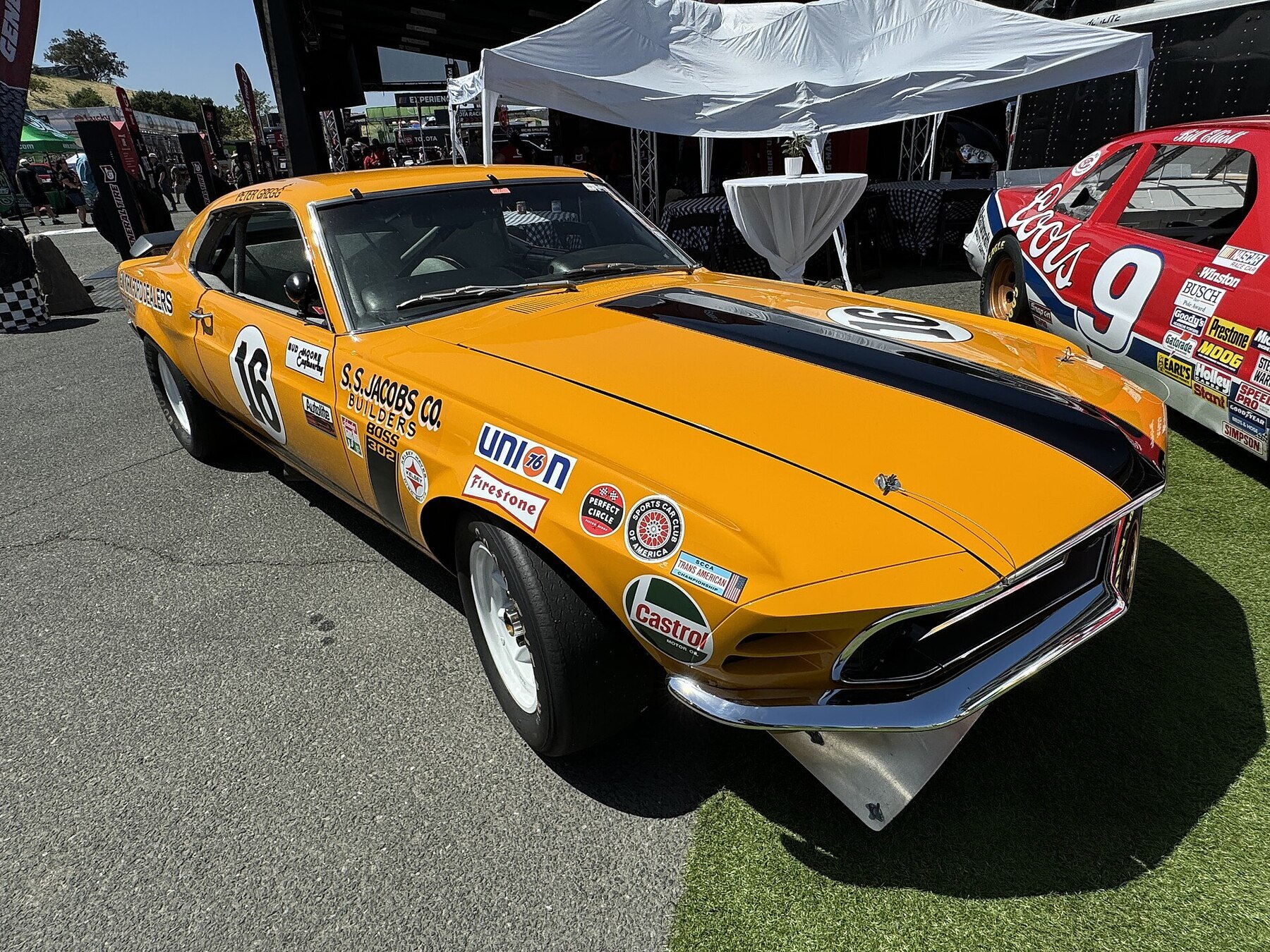
1970 Ford Mustang Boss 302 Trans-Am race car
Photo: Sarah Stierch (Wikimedia Commons user Missvain) · Source · CC0
Image rights & changes
Creator
Sarah Stierch (Wikimedia Commons user Missvain)
Exact source
Open source record
Use basis
The creator released the exact file under CC0; creator and source are retained for provenance.
Changes
Reuses the approved gallery derivative: auto-oriented, resized, and metadata removed.
Original identity
Commons SHA-1: 29d54fd623b7fc95bff3f87ccc52418e9f0ed510
Public derivative checksum
SHA-256: 53aa6f2f363d3a47a66ecd27185dad88423ddb59097946cf4b2252ef86eb5558
Rights record checked
July 26, 2026

Trans-Am

Bud Moore Boss 302 Trans-Am Mustang

The Boss 302 street car existed because Trans-Am rules required Ford to sell a homologation package for the five-liter class. The racing version became one of the defining Mustang competition stories when Bud Moore fielded Boss 302s for Parnelli Jones and George Follmer.

After a frustrating 1969 season against Penske's Camaros, Moore later recalled pressing Firestone over tire durability and said he threatened a Goodyear switch; he credited Firestone with improving the tires for 1970. Moore's team then took Ford to the manufacturers' title. Jones became the driver most closely tied to the orange No. 15 Mustang, while Follmer gave the team the second spear point it needed all season.

Larry Shinoda’s cross-marque story follows the Corvette-connected designer to Ford and explains how his Boss 302 work fit the wider Mustang–Camaro performance argument.

Where surviving cars are
Documented Boss 302 Trans-Am cars and restorations appear in historic racing, concours fields, museums, and private collections. The key is matching a car to team records, period photos, and continuous ownership history.
Why it matters
It is Mustang's cleanest factory-backed answer to Camaro in the pony-car road-racing wars.
People tied to it
Bud Moore, Parnelli Jones, George Follmer, Larry Shinoda, Lanky Foushee.
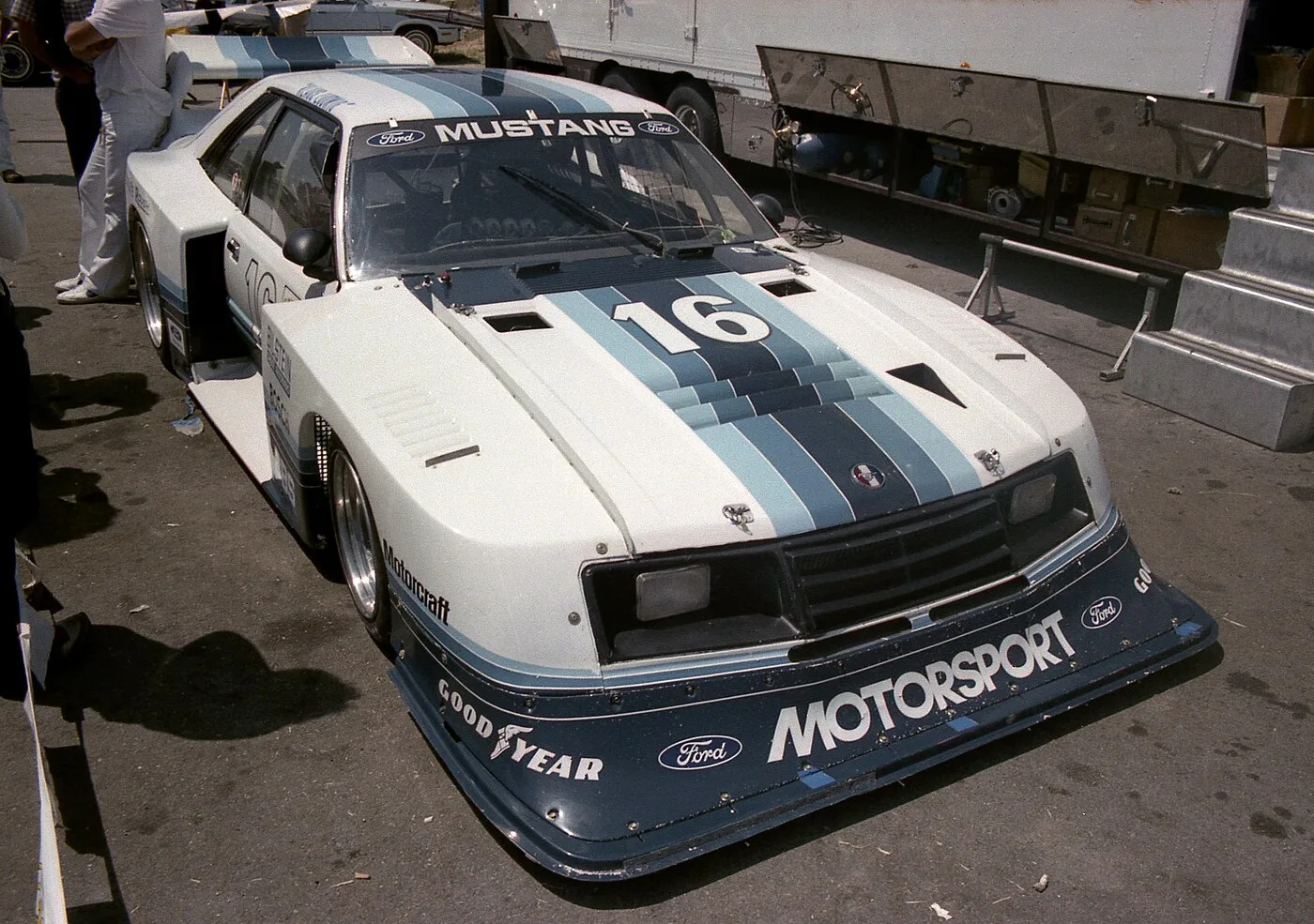
Zakspeed Roush Mustang Turbo in the Laguna Seca paddock in 1982
Photo: Dan Wildhirt · Source · CC BY-SA 3.0
Image rights & changes
Creator
Dan Wildhirt
Exact source
Open source record
Use basis
CC BY-SA 3.0; this web adaptation is offered under the same ShareAlike license.
Changes
Downloaded as a 1,400-pixel Commons derivative, auto-oriented, converted to WebP, and metadata removed.
Original identity
Commons SHA-1: 5f1a067d6c9c07ff692ffa78b9e04ece87f6edae
Public derivative checksum
SHA-256: f2b1c79d15a45fa4c269368610d2b57240c2eb7f03ba9160eac2773ded7f300e
Rights record checked
July 26, 2026

IMSA GTX and GTP

Zakspeed/Roush Mustang Turbo

The Zakspeed/Roush Mustang Turbo is one of the strangest and most fascinating Mustang-shaped race cars: a composite monocoque, turbocharged four-cylinder, wide-body IMSA machine tied to Bob Riley, Jack Roush, Zakspeed, and Klaus Ludwig. It led into the purpose-built Mustang GTP program.

The program led into the purpose-built 1983 Mustang GTP, but the Zakspeed/Roush Turbo is already important on its own: it shows how far Ford and its partners were willing to stretch Fox-era Mustang identity inside IMSA's experimental years.

Where surviving cars are
Individual chassis histories should be checked against IMSA entries, restoration records, and owner documentation because these were low-volume purpose-built race cars.
Why it matters
It connects Fox-era Mustang imagery to IMSA's wild prototype years.
People tied to it
Bob Riley, Jack Roush, Klaus Ludwig, Bobby Rahal, Geoff Brabham, Tim Coconis.
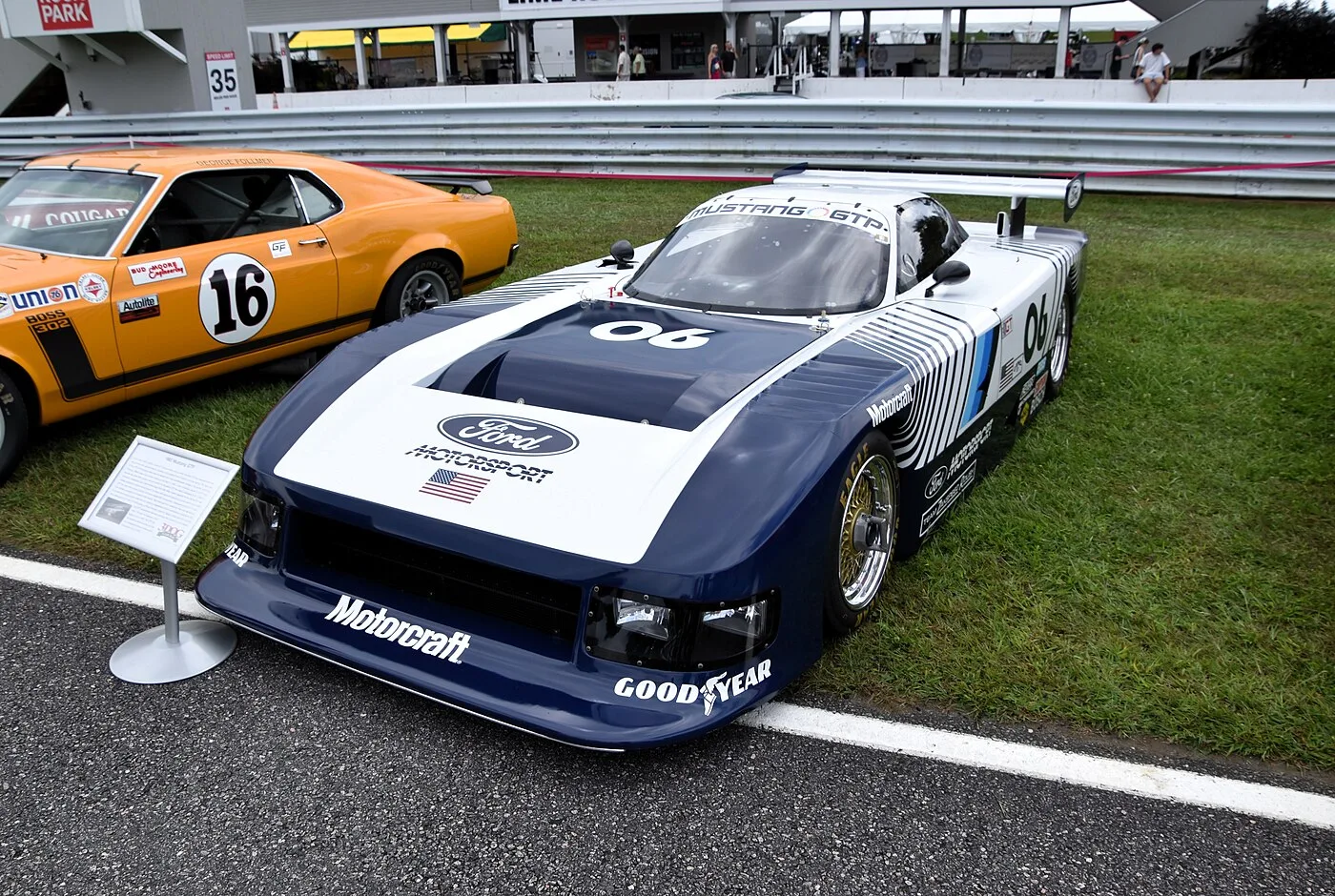
1983 Ford Mustang GTP at the Lime Rock Historic Festival
Photo: Charles from Port Chester, New York · Source · CC BY 2.0
Image rights & changes
Creator
Charles from Port Chester, New York
Exact source
Open source record
Use basis
CC BY 2.0 with creator, exact source, license, and changes identified.
Changes
Downloaded as a 1,400-pixel Commons derivative, auto-oriented, converted to WebP, and metadata removed.
Original identity
Commons SHA-1: 4633f28db13525d0af7e4a8863740855d41f74a0
Public derivative checksum
SHA-256: 93ba8a1efba0fa9f154ca5bde19b68ead48a76fe22a5e878e779798751bab59f
Rights record checked
July 26, 2026

IMSA prototype

1983 Mustang GTP

The Mustang GTP moved beyond a silhouette GT car into prototype engineering. Bob Riley designed a front-engine IMSA GTP machine with composite construction, ground-effects thinking, and turbocharged four-cylinder power, an unusual layout in a class that usually rewarded mid-engine packaging.

Its debut was spectacular: Tim Coconis and Klaus Ludwig won the 1983 Road America 500, while Bobby Rahal and Geoff Brabham put the sister car third overall and second in GTP. The promise faded quickly through reliability trouble and program tension, which makes the car fascinating rather than tidy.

Where surviving cars are
Recent public photos place at least one 1983 Mustang GTP at Lime Rock Historic Festival 42. Exact chassis identity should be checked through IMSA records, restoration files, and owner documentation.
Why it matters
It is one of Mustang's wildest links to IMSA's prototype era and a reminder that Fox-body branding reached far beyond showroom racing.
People tied to it
Bob Riley, Jack Roush, Klaus Ludwig, Tim Coconis, Bobby Rahal, Geoff Brabham.
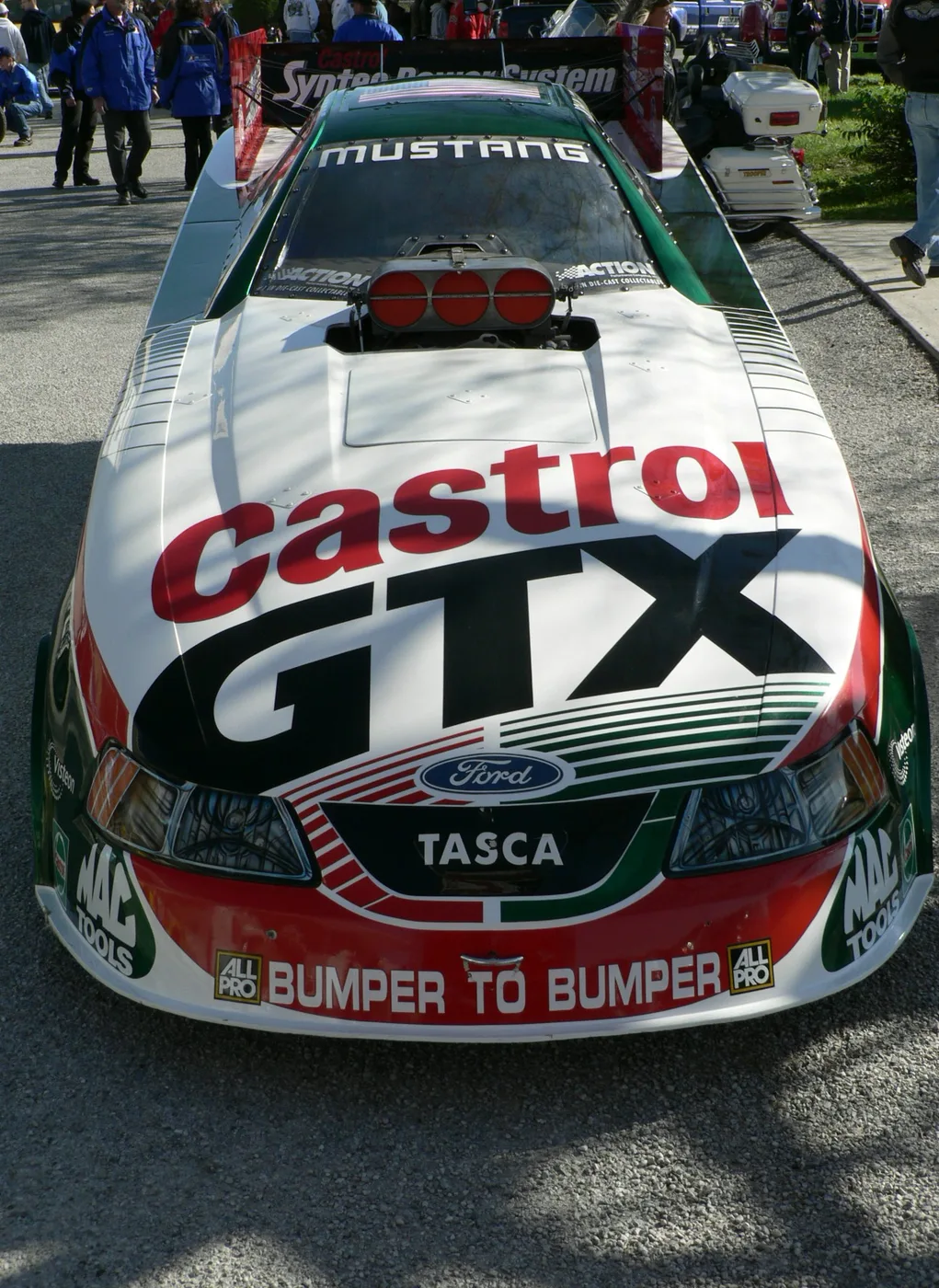
John Force Ford Mustang Funny Car on display
Photo: cole24_ · Source · CC BY-SA 2.5
Image rights & changes
Creator
cole24_
Exact source
Open source record
Use basis
CC BY-SA 2.5; this web adaptation is offered under the same ShareAlike license.
Changes
Auto-oriented, resized to 1,400 pixels tall, converted to WebP, and metadata removed.
Original identity
Commons SHA-1: 92053e21c9a088bc3ca847d810e0b9f2491fa6bc
Public derivative checksum
SHA-256: 21f26ddc3f16442943472c8a9772616c6b23a562d7a899669e25bafd3ecb7aab
Rights record checked
July 26, 2026

NHRA drag racing

John Force Mustang Funny Car and Ford drag-racing continuity

Mustang racing history is not limited to road courses. Ford's drag-racing branch runs through Bob Glidden's Pro Stock discipline, John Force's Mustang-bodied Funny Cars, and a fan culture where a grille shape or body decal can make a purpose-built race car feel connected to the showroom.

Funny Cars are extreme machines, so provenance works differently from a Shelby or Trans-Am car. A display car, race-used chassis, spare body, and restored showpiece can all look similar from a few feet away. The season, sponsor, body shell, and team paperwork matter.

Where surviving cars are
Force-era Mustang Funny Cars and Glidden-era Ford drag cars appear in team displays, museums, private collections, and promotional collections. Treat each car as a chassis-and-body research project.
Why it matters
It keeps Mustang's competition story connected to NHRA fans, not only Shelby and Trans-Am followers.
People tied to it
Bob Glidden, John Force, Austin Coil, John Force Racing, Ford performance teams.

Racing People

Racing people every Mustang fan should know

Ken MilesDevelopment driver and racer central to Shelby American's GT350R credibility.
Jerry TitusSports Car Graphic editor turned Shelby driver, GT350 winner, and 1967 Trans-Am champion for Ford.
Parnelli JonesThe Boss 302's headline driver and the face of the 1970 Bud Moore Trans-Am campaign.
George FollmerBud Moore teammate, Mustang winner, and one of the era's most versatile American road racers.
Bud MooreTeam owner and builder whose preparation made the Boss 302 a championship car.
Lyn St. JamesSCCA, IMSA, endurance, and Indy racer whose Ford story sits near Mustang's broader competition world.
Bob GliddenFord Pro Stock champion who brings Mustang history into quarter-mile competition.
John ForceNHRA Funny Car champion whose Ford Mustang-bodied cars made modern drag-racing audiences notice.
Jack RoushBuilder behind major IMSA, Trans-Am, road-car, and tuner chapters in modern Mustang performance.
Scott Maxwell and Billy JohnsonModern Mustang road-racing anchors, including Multimatic's S550 Shelby GT350R-C success.

Sources

  1. Ford Mustang racing overview
  2. Shelby Mustang reference
  3. 1965 Shelby GT350 image license page
  4. Boss 302 Mustang and Trans-Am reference
  5. Boss 302 Trans-Am image license page
  6. Ford Zakspeed Mustang Turbo reference
  7. Ford Mustang GTP reference
  8. 1983 Mustang GTP image license page
  9. Zakspeed/Roush Mustang image license page
  10. John Force Funny Car image license page
  11. Motorsports Hall of Fame of America: Bob Glidden
  12. Motorsports Hall of Fame of America: John Force
  13. Jerry Titus reference
  14. Lyn St. James reference